[ENGLISH] The Hand-House of Imagination
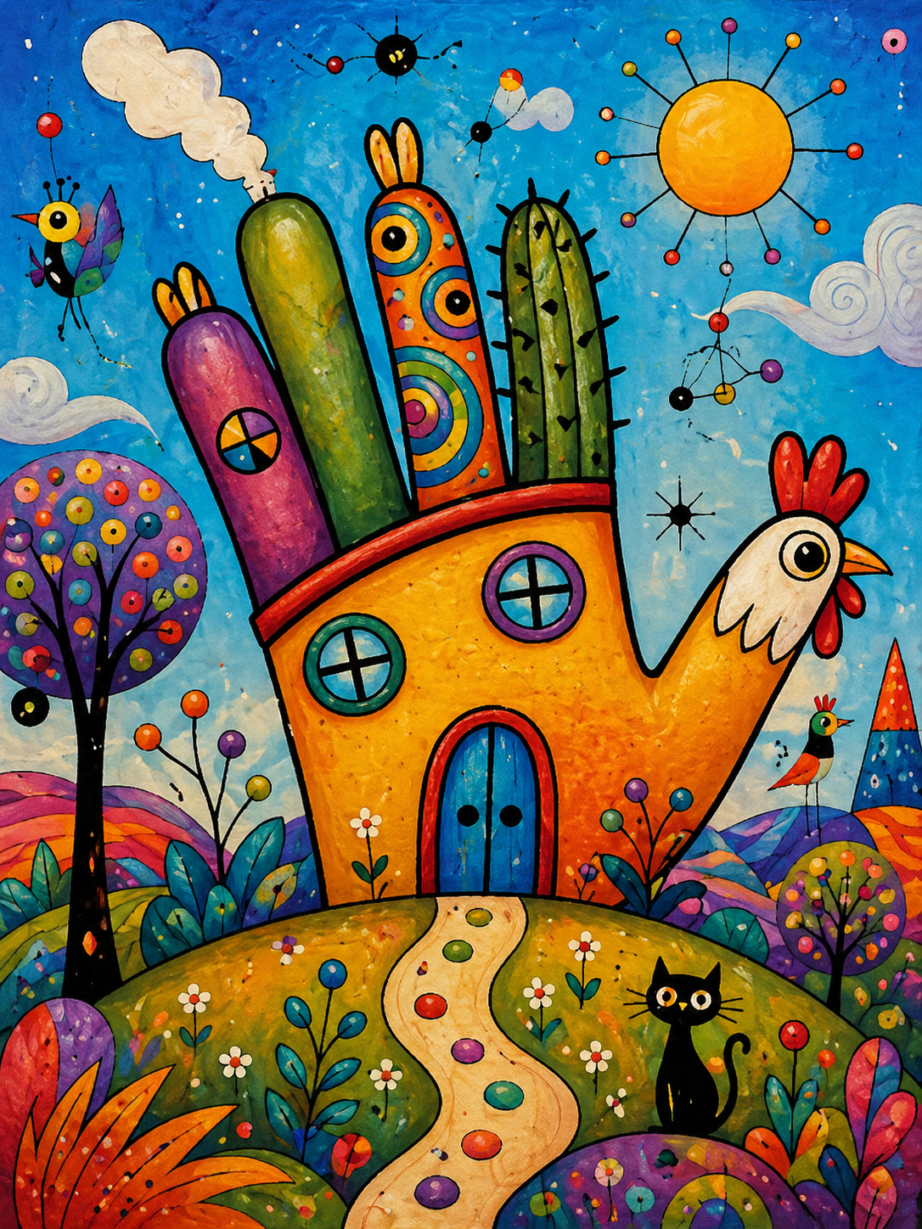
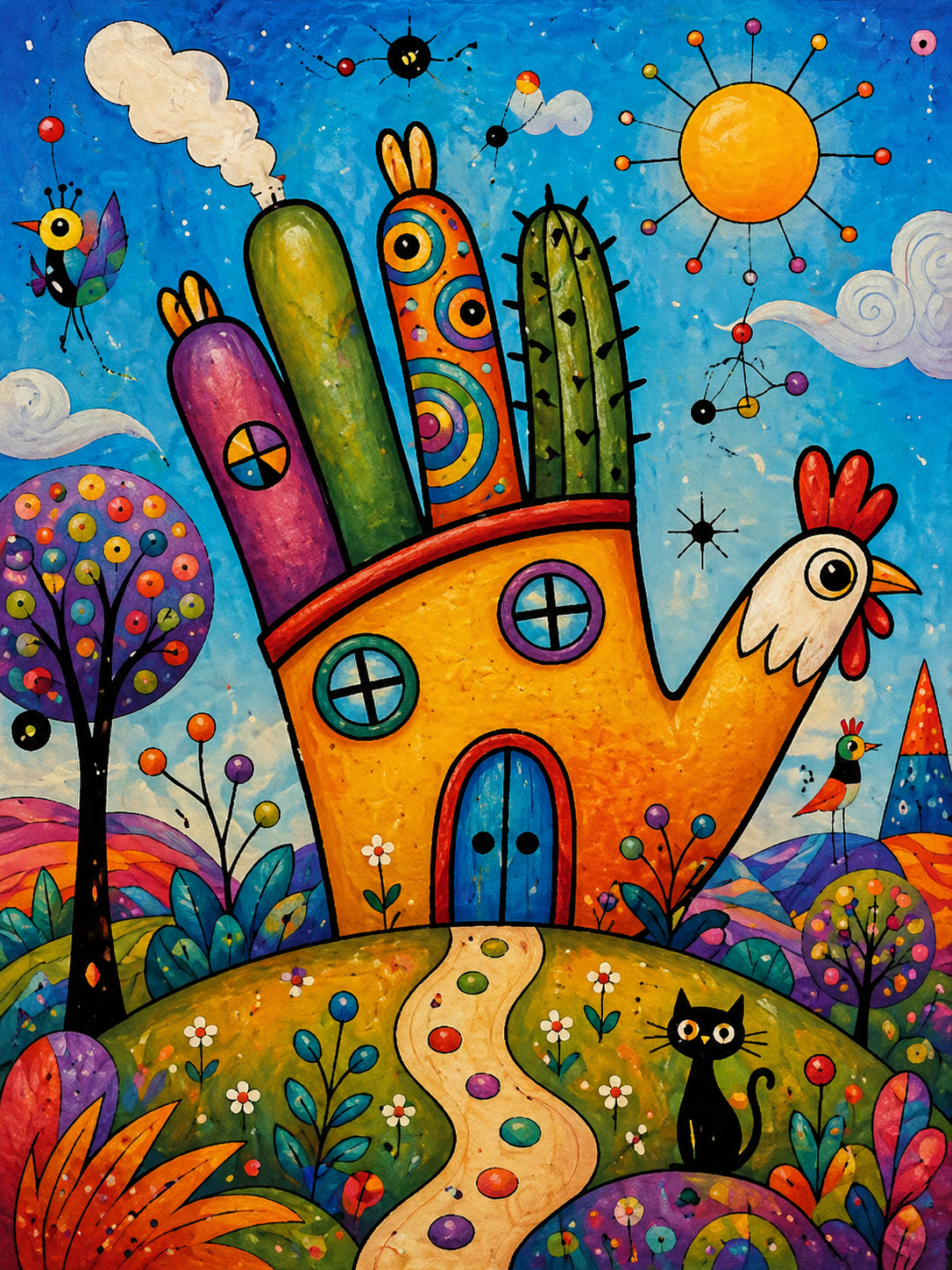
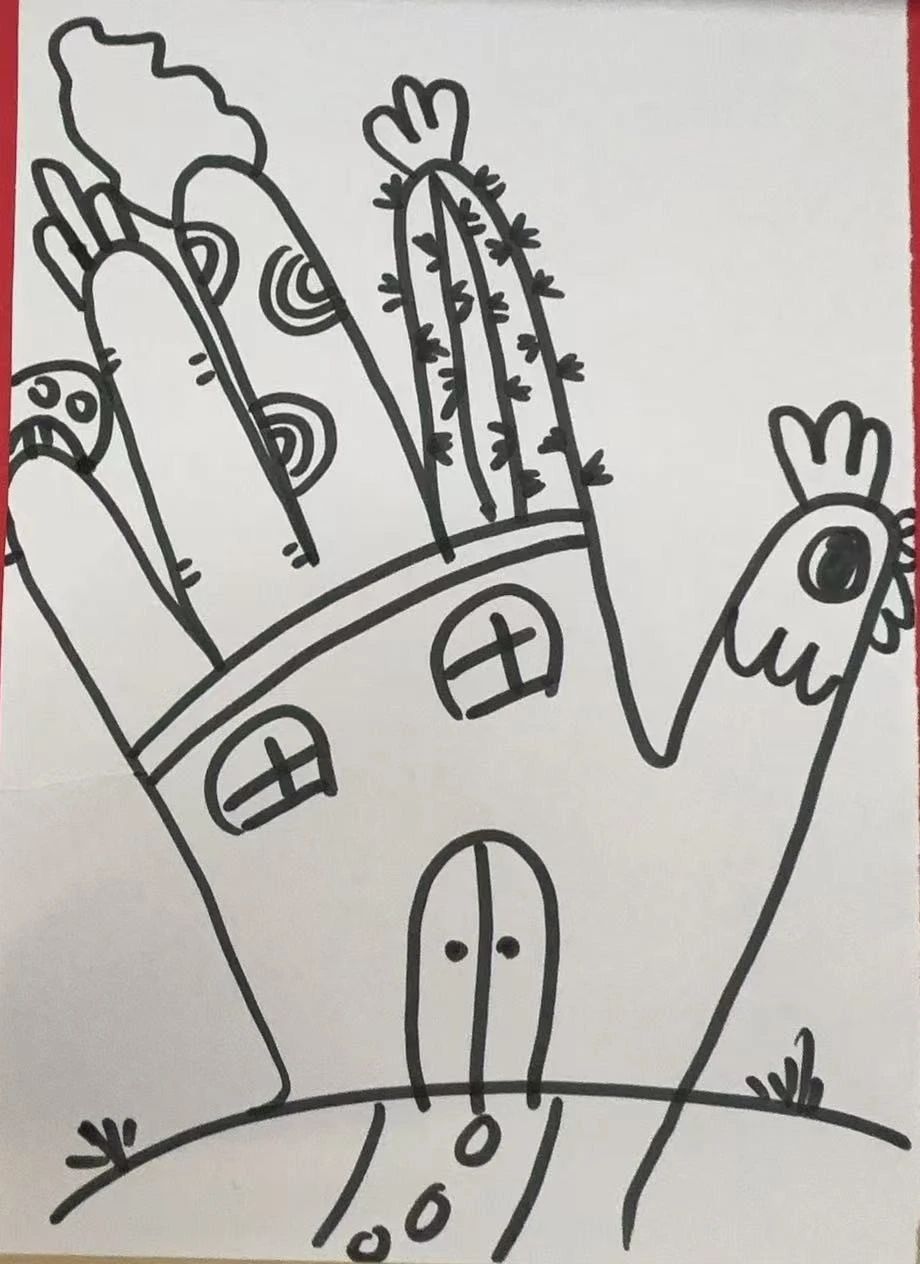
This artwork transforms a simple childlike line drawing into a vivid surreal landscape where the house becomes a living hand. The original sketch provides the essential structure: a palm-shaped dwelling with a central door, round windows, and fingers that change into playful forms such as a chimney, cactus, and chicken head. In the completed image, this idea is expanded into a colorful fantasy world. The hand is no longer only a body part; it becomes architecture, shelter, creature, and imagination at the same time. This transformation reflects the spirit of Surrealism, where familiar objects are recombined in unexpected ways, and it also carries the innocence of Naive Art through bold outlines, direct shapes, and joyful exaggeration. The composition uses strong black contours to hold together intense colors: yellow for the house, blue for the door and sky, green for the cactus finger, orange and purple for decorative patterns, and red accents for warmth and rhythm. The background adds emotional richness through a whimsical sun, patterned trees, birds, flowers, a black cat, rolling hills, and floating abstract marks. These surrounding details create a dreamlike ecosystem, as if the hand-house belongs to a world built by children’s imagination. The circular windows, spiral motifs, dotted plants, and symbolic birds echo Joan Miró’s playful visual language without becoming too complex. The work celebrates creativity as transformation: a child’s simple drawing becomes a complete narrative space where home, body, nature, and fantasy merge into one poetic image.
[TRADITIONAL_CHINESE] 想像之手的房子
這件作品將一幅單純的兒童線描轉化為色彩豐富的超現實風景。原始草圖提供了最重要的造型骨架:一棟像手掌一樣的房子,掌心有門與圓形窗戶,手指則變化成煙囪、仙人掌、雞頭等充滿童趣的元素。在完成圖中,這個概念被進一步擴展成一個完整的幻想世界。手不再只是身體的一部分,而同時成為建築、家園、生命體與想像力的容器。這種轉化具有超現實主義的精神,因為它把日常熟悉的物件重新組合成不合常理卻富有詩意的形象;同時也呈現樸素藝術的直覺特質,例如粗黑外輪廓、直接明快的造型、鮮豔色塊與孩子般的誇張比例。畫面以強烈的黑色線條統一構圖,再以黃色、藍色、綠色、橘色、紫色與紅色建立活潑節奏。背景中的太陽、捲雲、彩色樹、鳥、花朵、黑貓、山丘與漂浮的抽象符號,讓整個場景像是一個由兒童夢境生成的小宇宙。圓窗、螺旋、點狀果實與奇異鳥形呼應了米羅式的符號感,但仍保有孩子創作的自由與天真。這幅作品的核心價值在於展現創造力的轉化能力:一張簡單的黑白線稿,可以被發展成融合家、身體、自然與幻想的詩意空間。
[SIMPLIFIED_CHINESE] 想象之手的房子
这件作品把一幅简单的儿童线描发展成了一个鲜艳而完整的超现实童话场景。原始草图中最有力量的部分,是房子被画成一只手:掌心成为屋身,中央有门和圆窗,几根手指分别变化成烟囱、仙人掌、鸡头以及带有图案的奇异柱状形体。在最终图像中,这个想法被充分放大,手形房屋变成一个既像建筑、又像生命体、也像幻想机器的形象。它体现了超现实主义把熟悉事物重新组合的特点,同时也保留了朴素艺术的童真、直接和自由。画面使用粗黑线条勾勒主要轮廓,使复杂的色彩仍然保持清晰结构。黄色手掌房屋带来温暖与安全感,蓝色门窗形成视觉焦点,绿色仙人掌和橙色装饰手指增加节奏,紫色、红色、粉色与青色则让整个世界充满节庆般的活力。背景并不是普通风景,而是一个被想象力激活的空间:太阳像会发光的符号,树上长满彩色圆点,天空漂浮着云、星点和抽象连线,小鸟、黑猫、花朵和山丘共同构成梦境般的生态。作品中圆形窗户、螺旋图案、符号化动植物和漂浮元素,都带有米罗式的游戏感。它的艺术意义在于证明儿童的简单构思可以成为高级视觉叙事的起点,让家、身体、自然与幻想在同一幅画中融合。
[FRENCH] La maison-main de l’imagination
Cette œuvre transforme un dessin enfantin très simple en un paysage surréaliste riche, lumineux et narratif. Le croquis original contient déjà l’idée principale : une maison en forme de main, avec une porte au centre de la paume, des fenêtres rondes et des doigts qui deviennent des éléments inattendus, comme une cheminée, un cactus ou une tête de poulet. Dans l’image finale, cette idée est amplifiée jusqu’à devenir un monde complet. La main n’est plus seulement une partie du corps ; elle devient à la fois maison, créature, paysage intérieur et symbole de création. Cette transformation appartient à l’esprit du surréalisme, car elle combine des objets familiers selon une logique de rêve. Elle garde aussi la fraîcheur de l’art naïf grâce aux contours noirs très visibles, aux formes directes, aux proportions libres et aux couleurs franches. La composition repose sur un contraste fort entre la structure dessinée et l’intensité chromatique. Le jaune de la maison évoque la chaleur du foyer, le bleu de la porte et du ciel apporte de la profondeur, tandis que le vert du cactus, l’orange, le violet et le rouge créent une énergie joyeuse. L’arrière-plan enrichit la scène avec un soleil décoratif, des nuages en spirale, des arbres à pastilles colorées, des oiseaux, des fleurs, un chat noir et des collines ondulantes. Ces détails donnent l’impression d’un univers inventé par l’imagination d’un enfant. Les motifs circulaires, les signes flottants et les animaux symboliques rappellent la poésie visuelle de Joan Miró. L’œuvre célèbre ainsi la capacité de l’art à transformer une esquisse spontanée en espace poétique où le corps, la maison, la nature et le rêve se rejoignent.
