[ENGLISH] A Night Garden of Childlike Imagination
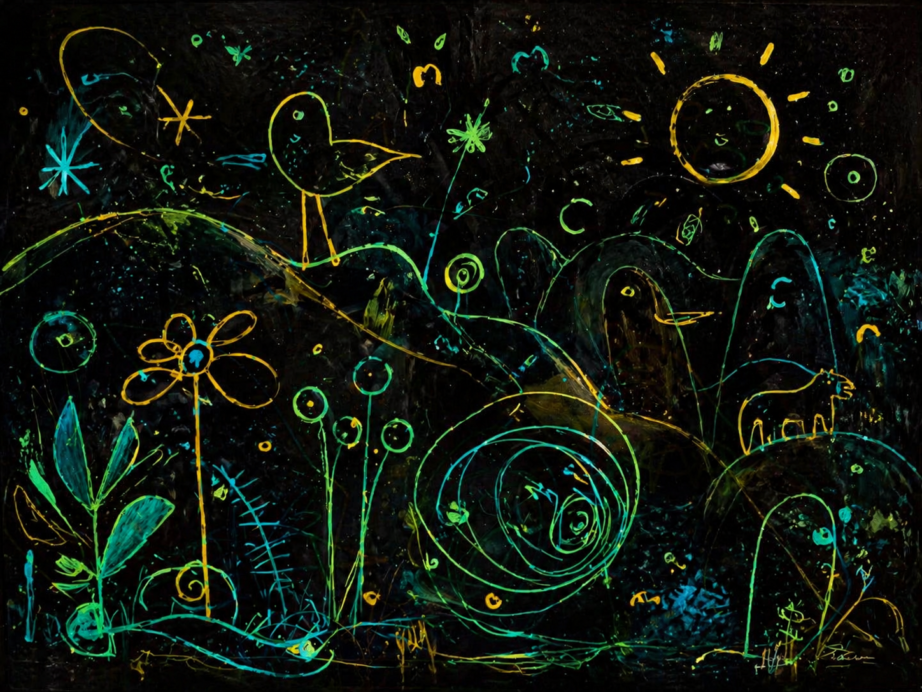
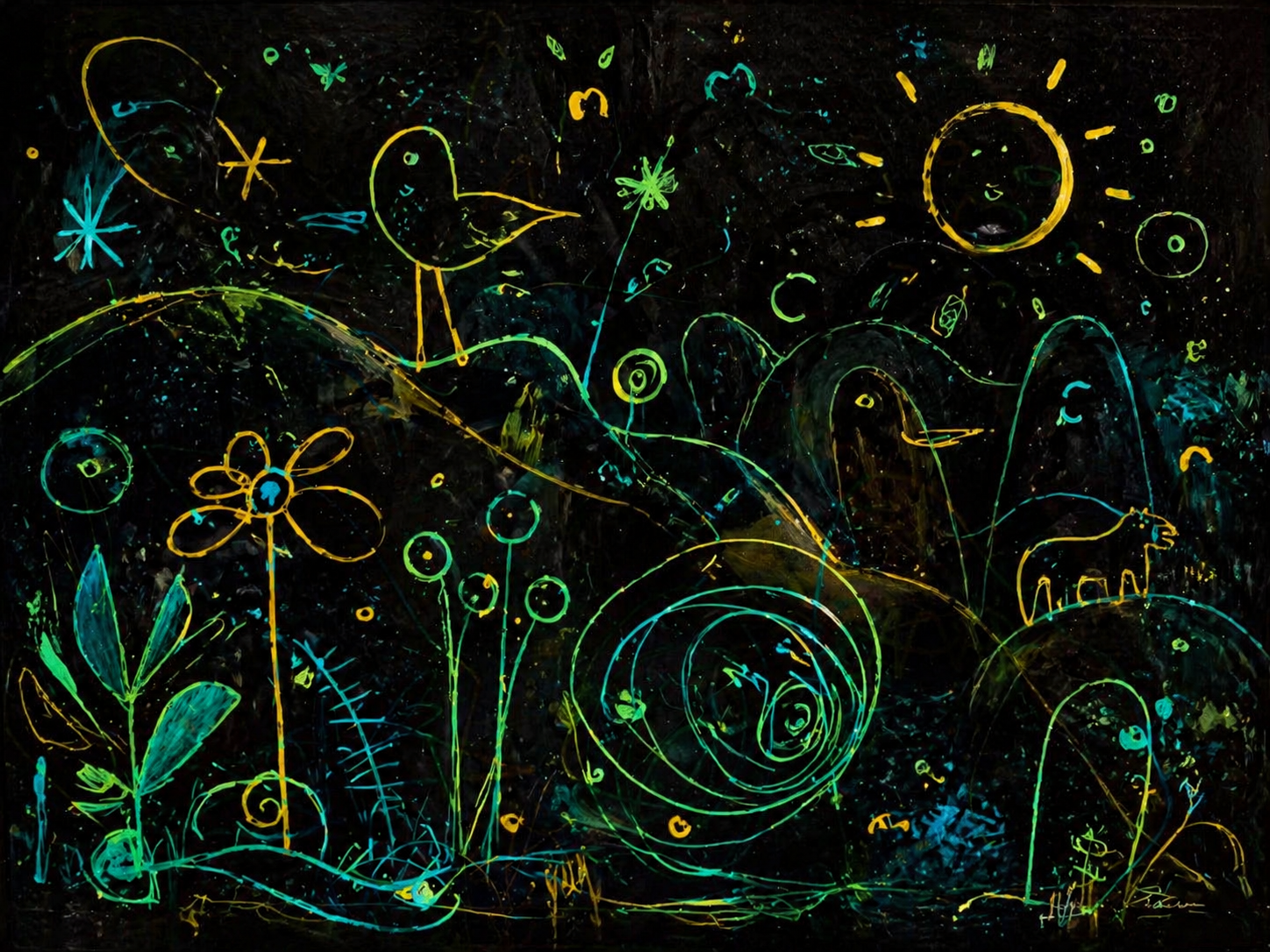
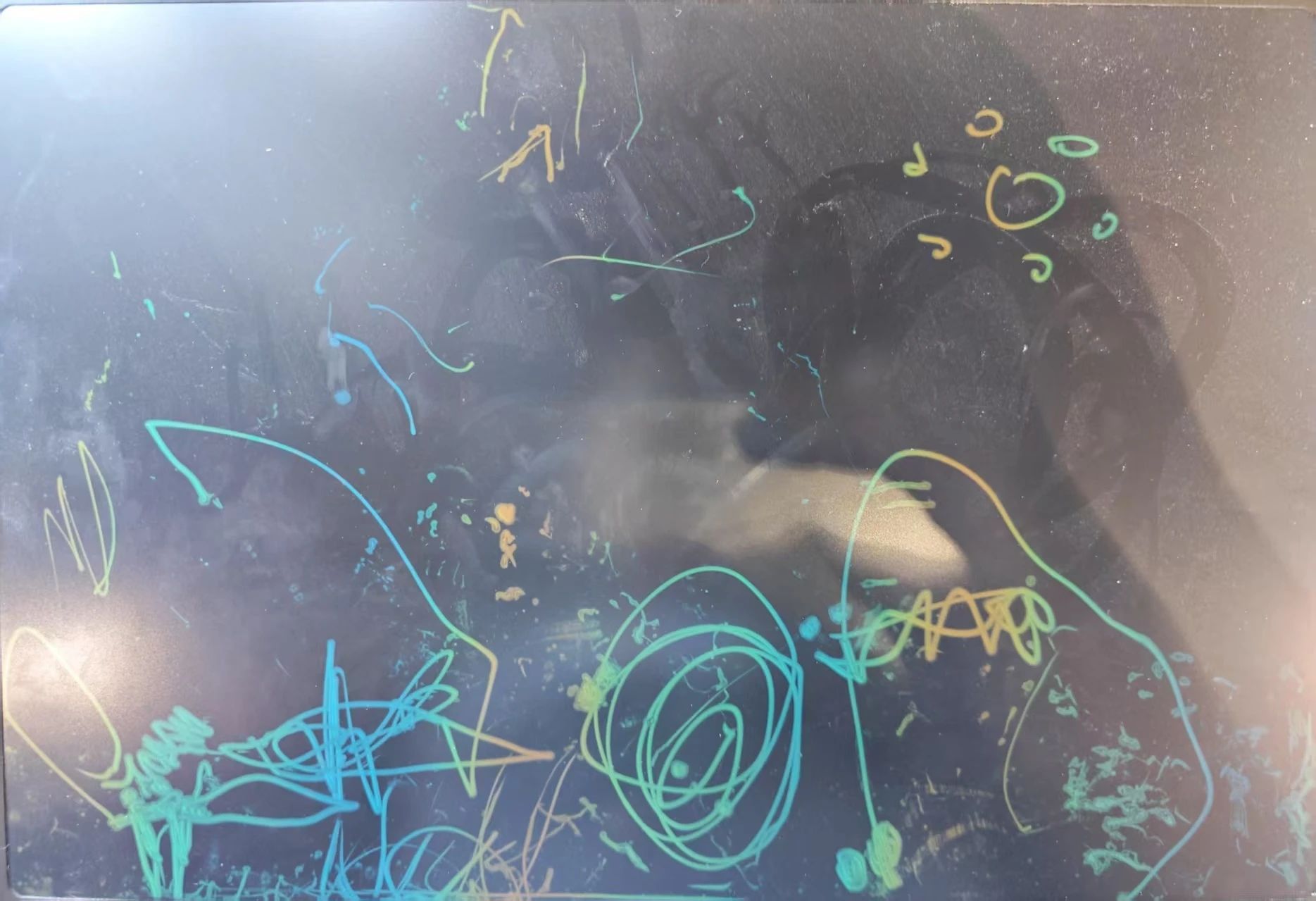
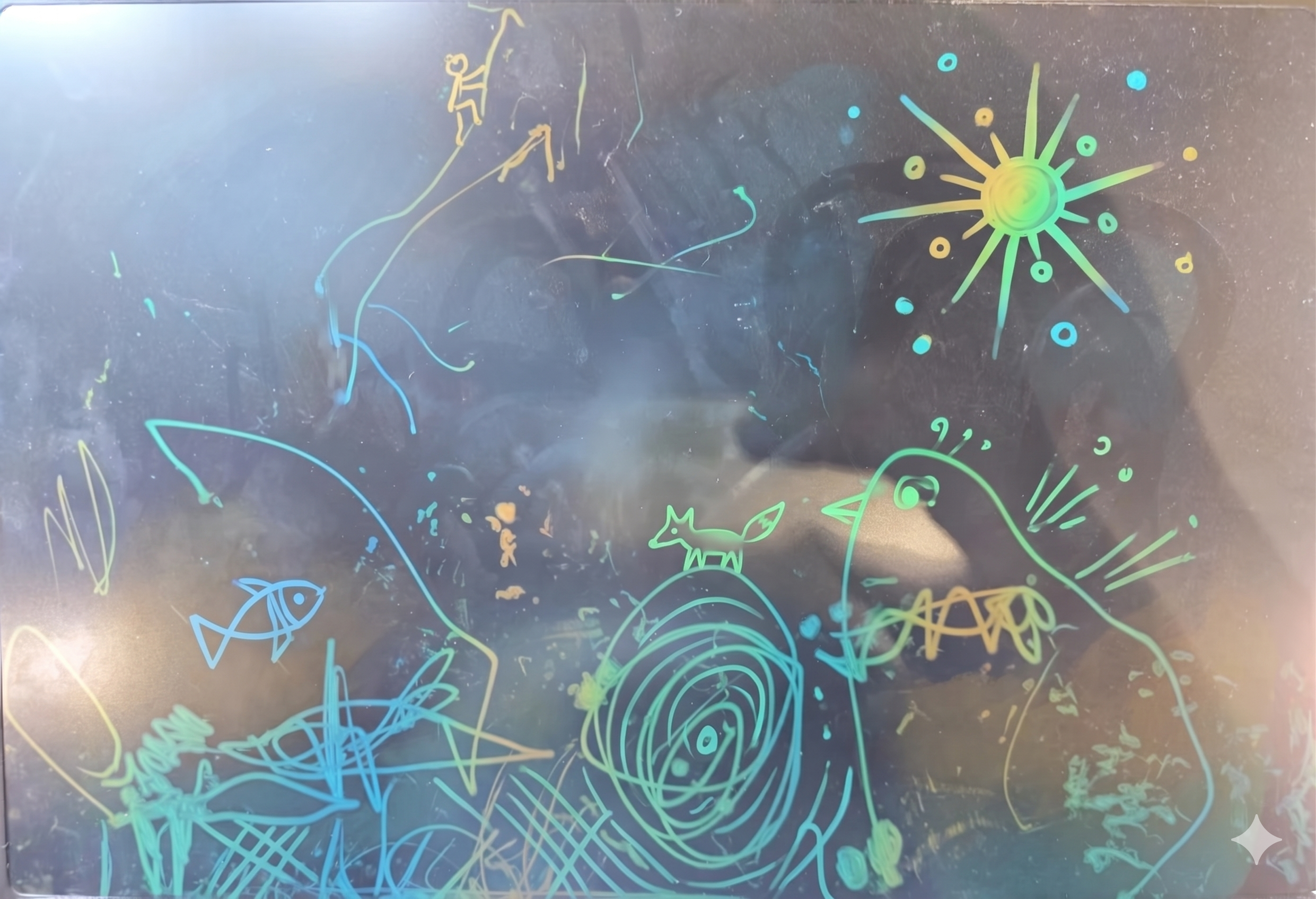
This artwork transforms a child’s spontaneous drawing into a luminous abstract world, where imagination becomes landscape, movement, and emotion. The black background acts like a night sky or theatrical stage, allowing the green, blue, and yellow lines to glow with unusual intensity. Instead of using realistic perspective, the image builds its space through rhythm: curved hills, spiraling paths, floating stars, circular suns, flowers, birds, and small animal-like figures appear as if they are emerging from a dream. The composition recalls the playful freedom associated with Joan Miró, especially the use of symbolic shapes, floating marks, and simplified creatures, but it also carries the direct emotional honesty of children’s art. Lines are not merely outlines; they are traces of movement, curiosity, and discovery. The bird standing on the hill, the flower rising from the lower left, and the round sun-like face in the upper right create a loose narrative of a magical garden at night. The original childlike marks remain visible in spirit: irregular, energetic, and unafraid of empty space or imbalance. Through digital refinement, the work gains depth, contrast, and visual density, while preserving the innocence of the first gesture. The result is not a polished illustration in the conventional sense, but an expressive map of inner vision. It suggests that childhood creativity does not need to explain itself; it only needs space to shine, wander, and connect natural forms with cosmic symbols.
[TRADITIONAL_CHINESE] 童心夜色中的幻想花園
這件作品將兒童自由塗畫轉化為一個發光的抽象世界,使想像力成為風景、動線與情感本身。黑色背景像夜空,也像劇場舞台,讓綠色、藍色與黃色線條產生近似螢光的強烈效果。畫面並不依靠寫實透視來建立空間,而是透過節奏形成結構:起伏的山丘、旋轉的線圈、漂浮的星星、圓形太陽、花朵、小鳥與簡化的動物形象,彷彿從夢境中逐漸浮現。作品帶有米羅式的童趣與符號性,特別是在漂浮圖形、簡化生物與自由線條的運用上;但它更重要的力量,來自兒童創作最直接、最真誠的情感。線條不只是輪廓,而像是行動的痕跡,記錄了探索、好奇與即興反應。站在山丘上的鳥、左下方生長的花,以及右上角帶表情的太陽,形成一段鬆散卻富有詩意的夜間花園敘事。原始兒童塗鴉的精神仍被保留下來:不規則、充滿能量,也不害怕空白、重疊或失衡。經過數位生成與視覺強化後,畫面增加了深度、對比與層次,但沒有失去第一筆線條的純真。它不是傳統意義上的精緻插畫,而是一張內在想像的地圖,提醒我們童年的創造力不必被解釋,只需要被看見、被保存,並被允許發光。
[SIMPLIFIED_CHINESE] 童年想象中的夜光花园
这件作品把儿童自发性的涂画转化成一个发光的抽象世界,让想象力成为风景、运动和情绪。黑色背景像夜空,也像一个安静的舞台,使绿色、蓝色和黄色线条呈现出强烈的荧光感。画面没有使用写实透视,而是通过线条节奏组织空间:起伏的山坡、旋转的圆圈、漂浮的星星、太阳、花朵、小鸟以及简单的动物形象,共同构成一个介于自然与梦境之间的场景。作品带有米罗式的符号感和童趣,尤其是漂浮的图形、自由的曲线以及被简化的生物造型;但它最核心的价值,仍然来自儿童绘画中直接、真诚、未经修饰的表达。这里的线条不是单纯的边界,而是动作留下的痕迹,记录了孩子的好奇、试探和即时反应。山坡上的鸟、左下角伸展的花、右上方带表情的太阳,让画面产生一种松散却可感知的故事性,好像夜晚的花园正在悄悄苏醒。原始图像中的随意、重叠、偏斜和不规则,被保留为重要的生命力。经过生成式图像的强化后,作品拥有更高的对比度、层次和视觉密度,但没有失去最初手绘的天真。它不是标准化的漂亮插画,而是一张童年内在宇宙的地图,说明真正的创造力往往来自不受规训的线条、游戏感和自由联想。
[FRENCH] Le jardin nocturne de l’imagination enfantine
Cette œuvre transforme un dessin spontané d’enfant en un univers abstrait et lumineux, où l’imagination devient paysage, mouvement et émotion. Le fond noir fonctionne comme un ciel nocturne ou une scène de théâtre, permettant aux traits verts, bleus et jaunes de briller avec une intensité presque fluorescente. L’espace n’est pas construit par une perspective réaliste, mais par le rythme des lignes : collines ondulantes, spirales, étoiles flottantes, soleil circulaire, fleurs, oiseaux et petites formes animales apparaissent comme les fragments d’un rêve. L’image évoque l’esprit ludique de Joan Miró par ses signes libres, ses créatures simplifiées et ses formes suspendues, tout en conservant la sincérité directe du geste enfantin. Les lignes ne sont pas seulement des contours ; elles sont les traces d’un mouvement, d’une curiosité et d’une découverte. L’oiseau posé sur la colline, la fleur qui s’élève en bas à gauche et le soleil expressif en haut à droite créent une narration ouverte, celle d’un jardin magique qui s’éveille dans la nuit. L’énergie du dessin initial demeure visible : irrégularité, superposition, déséquilibre et liberté deviennent des qualités plastiques essentielles. Grâce à la transformation numérique, l’image gagne en profondeur, en contraste et en densité visuelle, mais elle ne perd pas l’innocence du premier trait. Le résultat n’est pas une illustration simplement décorative, mais une carte poétique d’un monde intérieur. Il montre que la créativité enfantine n’a pas besoin d’être corrigée pour devenir œuvre ; elle a besoin d’espace, d’attention et de lumière.
